

Vintage is not a technical parameter. It is the wine’s narrative.
Some wines are designed to taste the same every year.
Consistency has become one of the most valuable currencies in the world of fine wine. Recognisable style, predictable structure and controlled expression are often considered hallmarks of quality. Many estates refine their cellar techniques precisely to minimise the visible effects of the vintage. Temperature control, extraction regimes, barrel management and careful blending enable producers to maintain a consistent house style, even when nature is unpredictable.
At Podere Il Carnasciale, however, the philosophy moves quietly in the opposite direction.
The estate produces one of the rarest wines in Italy: Caberlot, a mysterious grape variety thought to be a natural cross between Cabernet Franc and Merlot. However, it is not just the rarity that makes the wine so intriguing. What makes Caberlot compelling is something far less obvious: it is a wine that refuses to erase the vintage.
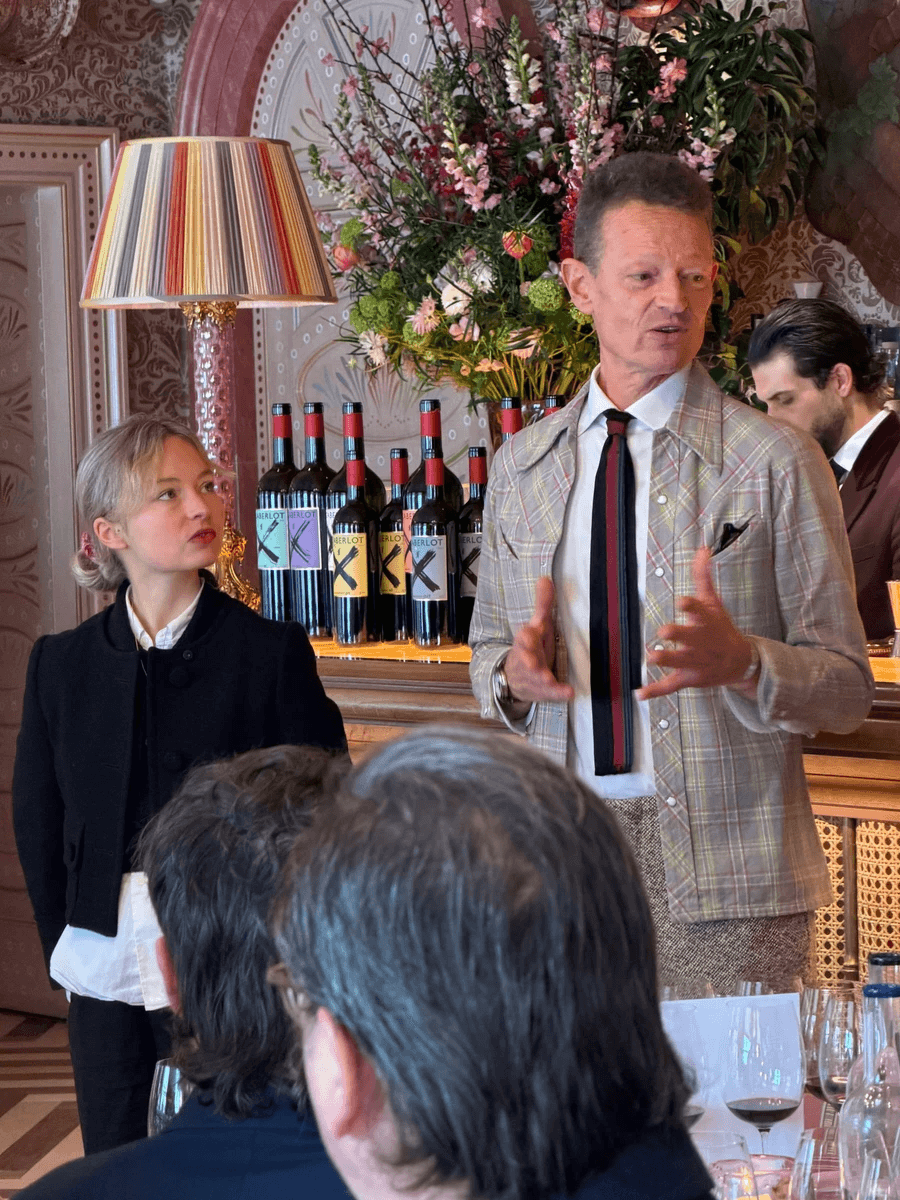
This idea emerged repeatedly during a recent vertical tasting in London, where Moritz Rogosky — who now runs the estate founded by his father, Wolf Rogosky — guided a group of tasters through several vintages of Caberlot alongside the estate’s second wine, Carnasciale. Rather than presenting the wines as examples of a carefully polished house style, Rogosky spoke about them as reflections of the seasons in which they were produced.
“Our wines are very marked by the vintage,” he explained.
The winemaking process itself changes remarkably little from year to year. Grapes are harvested by hand and sorted carefully in the vineyard. Fermentations take place in small stainless steel tanks, extraction is deliberately gentle and the wines are aged in barrels before spending an extended period maturing in the bottle. This approach is intentionally restrained. The aim is not to impose a style, but to preserve what the vineyard and the season naturally express.
In many modern wineries, technical precision is employed to iron out year-on-year variations. At Il Carnasciale, however, the same precision serves a different purpose. It creates a stable framework within which the characteristics of the vintage can be clearly discerned.
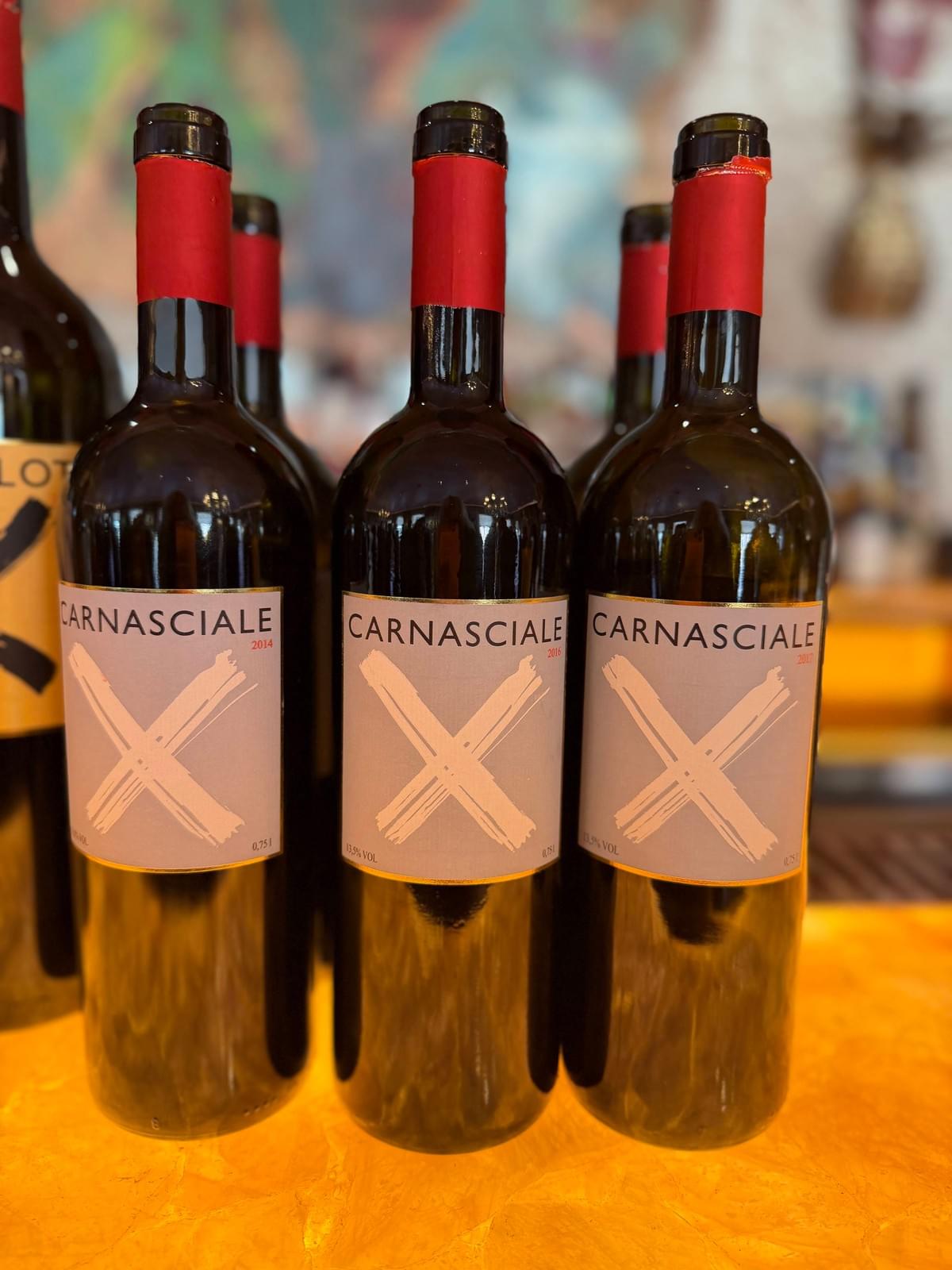
This philosophy is particularly striking when several vintages are tasted side by side. The lineup presented that afternoon, which included vintages such as 2014, 2016, 2017, 2019, 2020 and 2021, revealed the dramatic effect that changing conditions can have on the same grape variety. Some seasons produced wines that were generous and warm, while others emphasised tension, restraint, or structural power. These variations were not hidden; they were embraced.
In Caberlot, vintage is therefore not just a technical detail on a label. Instead, it becomes the central narrative of the wine — a record of how climate, vineyard and time intersect in a particular year.
Understanding this requires more than tasting a single bottle. It also involves examining the estate itself, the unusual origins of Caberlot, and the pivotal decision that defined Podere Il Carnasciale's identity from the outset.
The estate was built around an improbable idea. Before it became associated with one of the most unique wines in Tuscany, Podere Il Carnasciale was simply an abandoned place on a hill.
The estate lies in Valdarno di Sopra, in the southern Chianti mountains, about sixty kilometres south of Florence. It is currently managed by Moritz Rogosky alongside his mother, Bettina, and his daughter, Carla-Elle, continuing the project initiated by Moritz’s father, Wolf Rogosky.
Yet the origins of the estate were far from those of a traditional Tuscan winery.
In the early 1970s, Wolf and Bettina Rogosky purchased the property almost by accident. At the time, the farm was little more than a forgotten agricultural site. There was no road leading to the house, no electricity, no vineyard, no cellar and no reliable water supply. However, the landscape was remarkable: a remote hilltop surrounded by forests, wild vegetation and biodiversity.
For many years, the property remained simply a countryside retreat — a place to escape the city — rather than the foundation of a wine estate.
The turning point came in 1985, when a devastating frost swept across Tuscany, destroying olive trees throughout the region. The olive groves at Carnasciale were severely damaged, forcing the family to reconsider how the land might be used in future.
Rather than replanting olives, Wolf Rogosky decided to experiment with vines.
Around that time, he met Remigio Bordini, an agronomist whose role would prove decisive for the estate. Bordini introduced Rogosky to a variety of vine he had come across in northern Italy. The plant appeared to be a spontaneous cross between Cabernet Franc and Merlot.
It had never been cultivated commercially at the time.
There was no recognised category for it, no market demand, and no tradition of cultivation. Yet it was precisely this uncertainty that intrigued Rogosky.
In 1986, the first vineyard was planted at Carnasciale, covering just 0.3 hectares. This small experimental plot would eventually lay the foundations for one of Tuscany’s most unusual wines.
The grape was later named Caberlot, a word that subtly acknowledges its presumed parentage.
What made this decision so remarkable was that Caberlot did not fit into any recognised category. It was neither a traditional Tuscan variety, such as Sangiovese, nor a calculated imitation of Bordeaux varieties. It existed outside of these familiar frameworks.
In many ways, it was simply an exception.
This gradually became the estate's defining identity.
Moritz Rogosky later described the family background, shedding light on the philosophy behind the project. The Rogoskys did not come from a lineage of wine producers, but rather from what he calls 'a wine-drinking background'. Having been born in Germany, the family had also lived in New York and Paris, where they encountered wine through travel, curiosity and culture rather than through an inherited agricultural tradition.
This distance from conventional wine culture gave them a certain freedom. They were not bound by regional expectations or family precedent, which allowed them to conceive of something unusual.
Over time, the original experiment evolved into a serious viticultural project. Additional parcels were planted in 1999 and 2004, gradually expanding the vineyard across various soils, including sandstone, sandy deposits, marine sediments, limestone and clay.
Today, the estate farms around 5.5 hectares of vineyards and produces approximately 20,000 bottles of wine each year. Caberlot remains the estate's defining grape variety, though small plantings of Sangiovese also contribute to its production.
Following Wolf Rogosky’s death in 1996, the project has continued under family leadership. Moritz Rogosky now runs the estate alongside technical director Marco Maffei, upholding the central commitment that has defined the project since its inception: to understand Caberlot rather than control it.
This is precisely why the estate's history matters, even before the wines are poured.
Podere Il Carnasciale is not simply interesting because Caberlot is rare.
It is interesting because the entire estate was built around the decision to treat that rarity seriously — not as a curiosity, but as a long-term viticultural endeavour.
Another decision that helped shape the identity of Il Caberlot was the choice of bottle.
For the first twenty-five vintages, Caberlot was released exclusively in the magnum format. In a region where large bottles are often reserved for celebratory releases or collectors' editions, Podere Il Carnasciale took the opposite approach: the magnum was not a luxury format, but simply the standard bottle size.
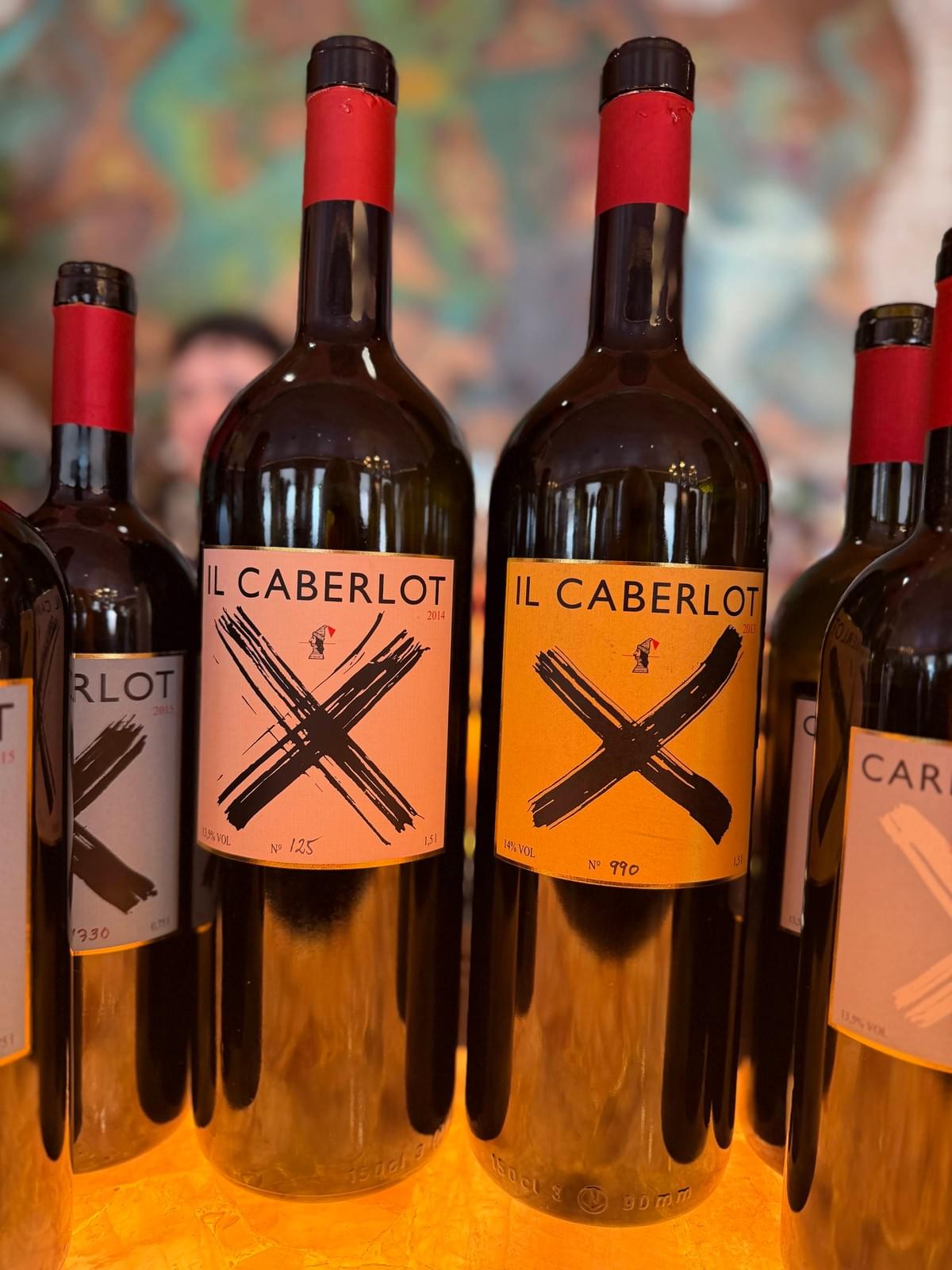
It was only in 2014 that the estate began producing a very small number of standard 750 ml bottles. Even today, Moritz Rogosky jokingly refers to them as 'demi-magnums', suggesting that the smaller format still feels slightly unusual within the estate's philosophy.
The idea originally came from Wolf Rogosky. It was not conceived as a marketing strategy or a means of creating scarcity, but rather as a conviction about how the wine should evolve over time.
Caberlot naturally combines moderate alcohol levels, vibrant acidity and finely structured tannins. According to Rogosky, it is these characteristics that allow the wine to benefit particularly from the slower ageing dynamics of larger formats. A magnum develops more gradually, preserving aromatic freshness while allowing the structure to integrate over many years.
From the outset, therefore, the bottle size was seen as part of the wine’s identity rather than merely its packaging.
“Magnum is almost the standard bottle size for us,” explains Rogosky.
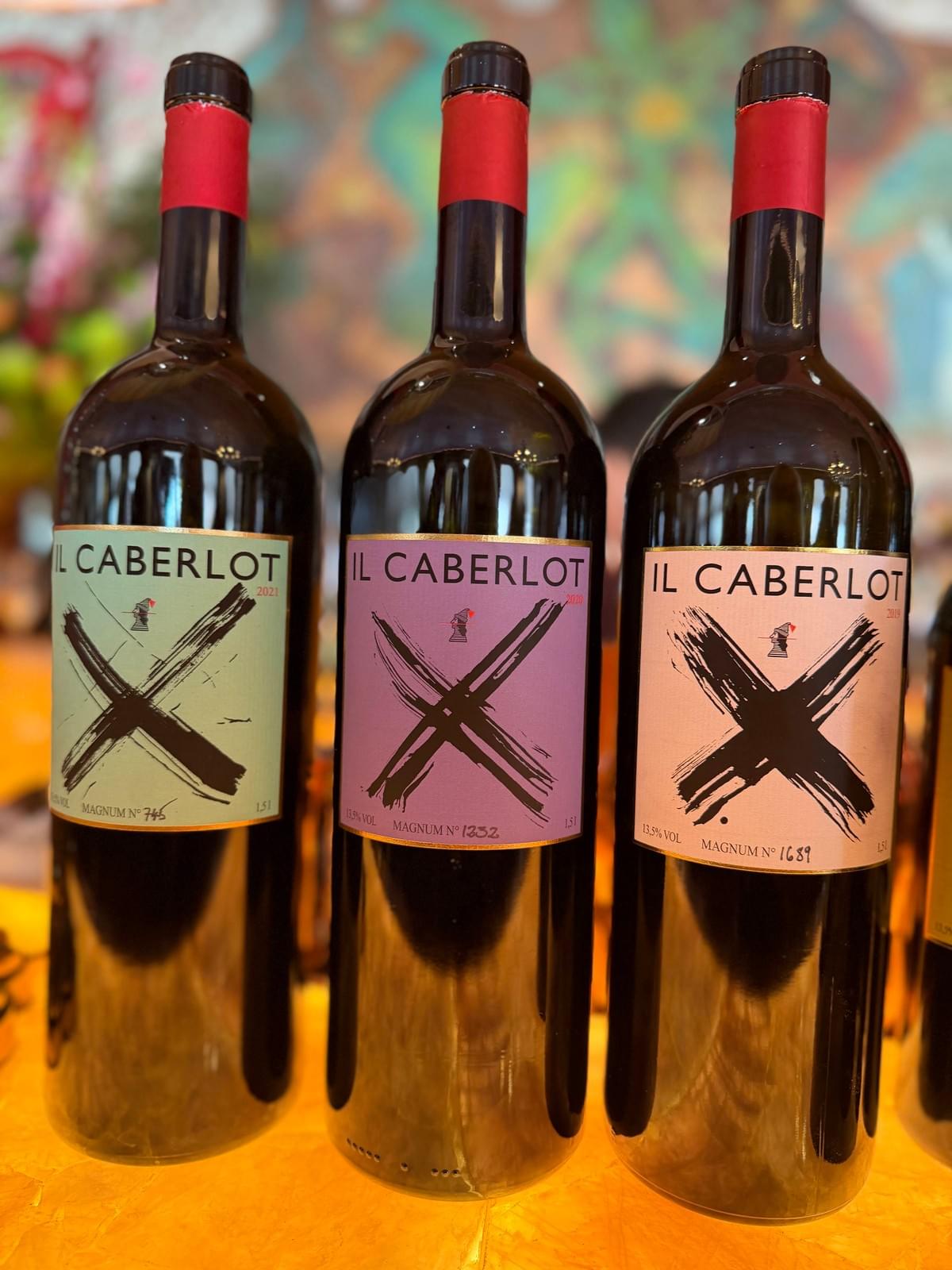
The format also reflects a certain philosophy of drinking. A magnum encourages sharing, conversation, and spending time at the table. It turns the simple act of opening a bottle into a small social occasion.
Rogosky often jokes that the size never feels excessive once the bottle is open.
‘The magnum is always empty by the end of the evening,’ he says with a smile.
This remark encapsulates something essential about the Caberlot style. Despite its rarity and capacity for long ageing, the wine is not intended to be monumental or intimidating. It retains an energy and aromatic brightness that make it approachable and inviting at the table.
In this sense, the magnum becomes more than just a container.
It becomes part of the wine's philosophy — a reminder that even the rarest bottles are ultimately meant to be shared.
Caberlot – the grape that defines the estate
If the magnum reflects Podere Il Carnasciale's philosophy, then Caberlot defines the estate's identity.
Few wines in the world are built around a grape variety that essentially exists in only one place. Caberlot remains almost entirely confined to Podere Il Carnasciale, making it one of the most unique varieties cultivated in contemporary viticulture. Believed to be a natural cross between Cabernet Franc and Merlot, the grape combines characteristics of both parents, yet ultimately behaves differently to both.
In theory, the lineage seems straightforward: Cabernet Franc contributes aromatic lift, herbal nuances and structural freshness, while Merlot is often associated with supple texture and generous fruit. Yet Caberlot rarely conforms to these expectations in a predictable way.
During the tasting, Moritz Rogosky described the variety in terms that capture both its charm and its complexity: 'A challenge, a diva, and a grape with very unique aromatics.'
The metaphor is revealing.
In the vineyard, Caberlot can have abundant foliage while producing relatively few grapes. The vines often develop abundant foliage, but produce relatively small quantities of grapes, which limits potential yields even further. Even when the crop appears healthy, harvesting rarely happens in a single pass. Different parcels and clusters may ripen at different speeds, necessitating several careful selections to ensure the fruit is picked at optimal maturity.
This behaviour partly explains why Caberlot never spread beyond the estate. For growers seeking reliability or scale, the variety offers few advantages. It is unpredictable, labour-intensive, and has a naturally low yield.
For the Rogosky family, however, this unpredictability was part of its appeal.
Rather than attempting to make the grape behave uniformly, the estate gradually expanded its vineyards to observe how Caberlot responds to different soils and exposures. Over time, this approach has transformed the property into a kind of living laboratory where each plot produces a slightly different interpretation of the same variety.
Understanding Caberlot therefore requires an examination not only of the grape itself, but also of the landscape in which it grows.
Today, the estate farms several vineyard parcels across the hills of Valdarno di Sopra, each contributing a slightly different expression of Caberlot.
The original vineyard at Carnasciale was planted in galestro, a red sandstone soil also found in the Chianti Classico region. Here, the vines are trained relatively high to introduce a degree of stress to the moisture-retaining soils. The resulting wines often exhibit a certain aromatic lift and structural clarity reflecting the mineral character of the site.
In 1999, a second vineyard known as Selva was planted in the valley on lighter, sandy soils. The vines here are trained in the Alberello (gobelet) style, producing wines that Rogosky describes as being slightly more generous and open in their youth.
A third site, Vincaia, which was planted in 2004 on slopes rich in marine sediments, adds another dimension to the final blend. Wines from this vineyard tend to show greater tension and linearity, and Rogosky often refers to them as the structural backbone of Caberlot.
Further plantings followed in subsequent years, including parcels such as Pe’Relli and Corparia. Each of these adds another layer of geological diversity, with clay-limestone soils, rocky slopes, and different elevations across the hills.
Together, these vineyards form a complex mosaic of terroir.
However, the intention is not to bottle wines from individual vineyards. Instead, the estate assembles Il Caberlot as a synthesis of these different sites, enabling the final blend to reflect the broader landscape rather than a single vineyard.
Over time, there has also been a subtle shift in the way new vineyard sites are selected. While earlier plantings prioritised sun exposure to ensure full ripening, more recent parcels increasingly consider how to protect the vines from excessive heat.
One of the newer vineyards, for instance, faces north — a decision that would have seemed counterintuitive only a few decades ago, but which now reflects the realities of a warming climate.
For a grape variety as sensitive as Caberlot, the interaction between the vineyard and the season becomes particularly apparent.
Each vineyard reacts slightly differently to rainfall, temperature, and sunlight, and these subtle variations accumulate over time to create distinct nuances in the final product. Understanding this mosaic of vineyards therefore changes the way the wines themselves are perceived.
Once the geography of the estate and the characteristics of the grape are understood, it becomes easier to grasp why Caberlot is so profoundly affected by the vintage.
Ultimately, this is where the story of the wine returns to the tasting table.
When several vintages are poured side by side, the wines reveal something deeper than just stylistic variation. They become a record of how climate, vineyard and time interact across different seasons.
Reading Caberlot vintage by vintage
If the vineyards of Podere Il Carnasciale form a mosaic of soils and exposures, the vintages reveal another dimension of the wine’s identity: the influence of the season.
Caberlot is a grape that reacts strongly to climatic variation. Its naturally low yields, relatively late ripening and sensitive aromatic profile mean that even subtle shifts in weather patterns can leave visible traces in the final wine. As the estate maintains a consistent approach in the cellar — with fermentation in small stainless steel tanks, gentle extraction through manual punch-downs, ageing in barrels followed by extended maturation in the bottle — the differences between vintages remain clearly perceptible.
Rather than smoothing these differences out, the winemaking philosophy allows them to remain visible.
This approach is particularly illuminating during a vertical tasting, when several vintages are placed side by side. Rather than a single, polished house style repeated with minor adjustments, what emerges is a series of wines that reflect the rhythm of the vineyard across very different seasons.
The tasting that afternoon offered exactly this perspective, revealing how Caberlot responds to years of balance, stress, and climatic extremes.
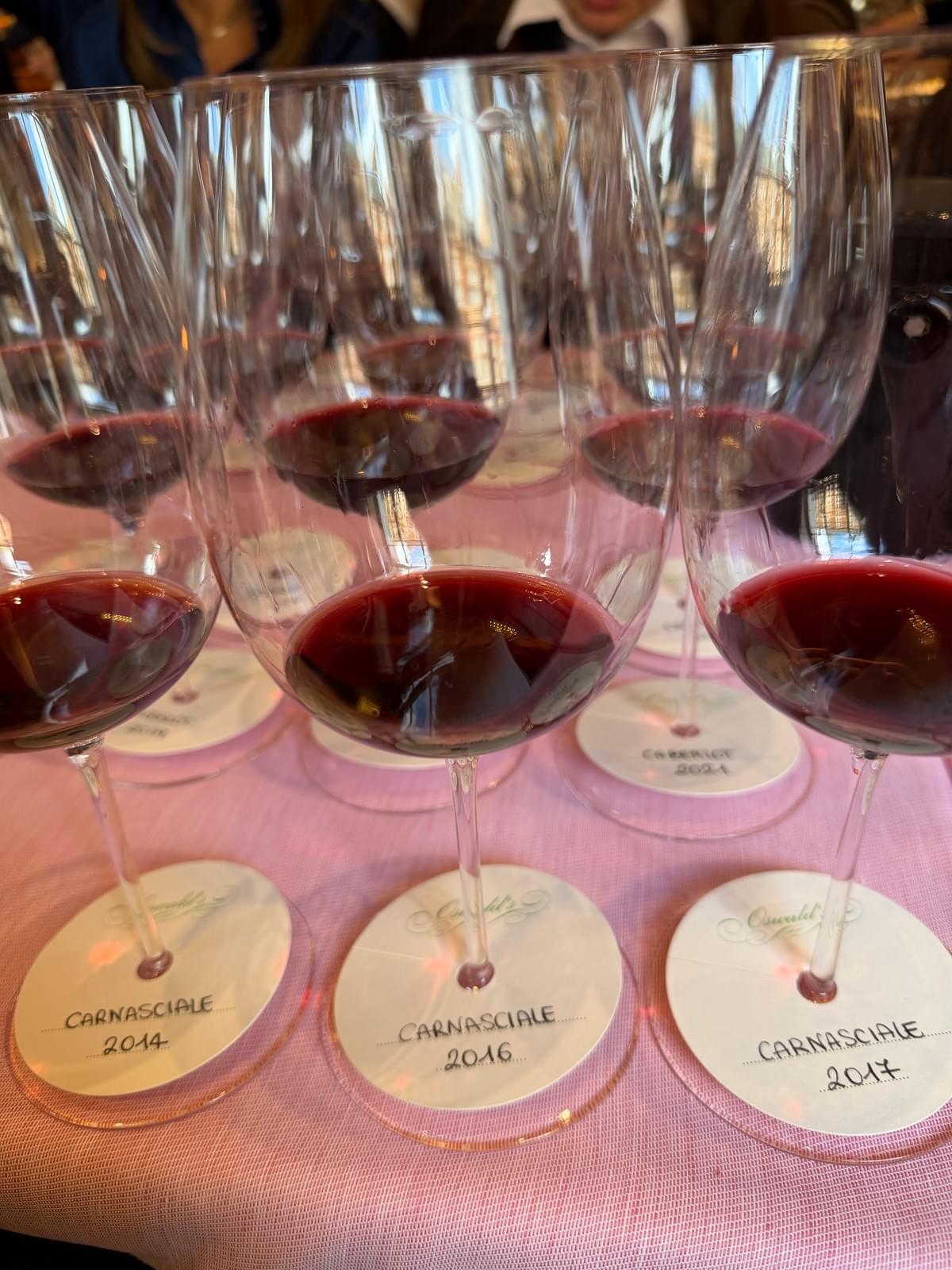
Moritz Rogosky described the 2014 vintage as 'upside-down', a phrase that captures both the unusual weather patterns of the year and the challenges they created in the vineyard.
The season began with a relatively warm winter, followed by a cool and rainy growing period that put considerable strain on the vines. One of the most challenging developments was the arrival of Drosophila suzukii, an invasive Asian fruit fly that emerged in Tuscany around that time, causing widespread damage to vineyards across the region.
At Carnasciale, the effects were felt not only in the vineyard, but also in the surrounding agricultural areas. The estate's Sangiovese vines were particularly affected, and the olive harvest failed completely due to the olive fly spreading.
Under such conditions, working in the vineyard required extraordinary care and strict selection.
The 2014 vintage wines show restraint rather than opulence. Rather than power or concentration, the vintage expresses a sense of tension and precision. The fruit profile appears lifted and finely drawn, while the structure remains linear and focused.
After the difficulties of 2014, the 2016 vintage offered something closer to equilibrium.
The season unfolded with relatively moderate conditions, enabling the grapes to ripen slowly and steadily without undue stress. For Caberlot, which can easily swing between extremes depending on the year, such stability enables the grape to express a more classical character.
In the glass, the 2016 wines show balance and composure. The tannins are refined, the acidity is well integrated, and the aromatics are poised between freshness and depth.
This is the kind of vintage that reveals the structural elegance of Caberlot when nature cooperates.
If 2016 represented balance, then 2017 illustrated the vulnerability of vineyards to climatic extremes.
The year began with a late frost at the end of April, damaging the first generation of shoots and forcing the vines to produce a second growth cycle. The stress of that event alone would have been significant.
What followed was even more dramatic.
For almost five months, there was no rain.
Under these conditions, the vines produced extremely small berries with thick skins and very little juice. Yields dropped by around forty per cent, which concentrated the remaining fruit but also placed considerable pressure on the vines.
The resulting wines demonstrate remarkable density and structure. However, according to Rogosky, the 2017 Caberlot still feels somewhat closed today; it is a wine whose full aromatic complexity may only emerge after further ageing.
In contrast to the challenges of 2017, the 2019 vintage unfolded under far more favourable conditions.
The growing season progressed calmly, allowing the grapes to ripen gradually without excessive heat stress. Rogosky considers 2019 to be one of those years where 'everything was in place', alongside vintages such as 2013 and 2021.
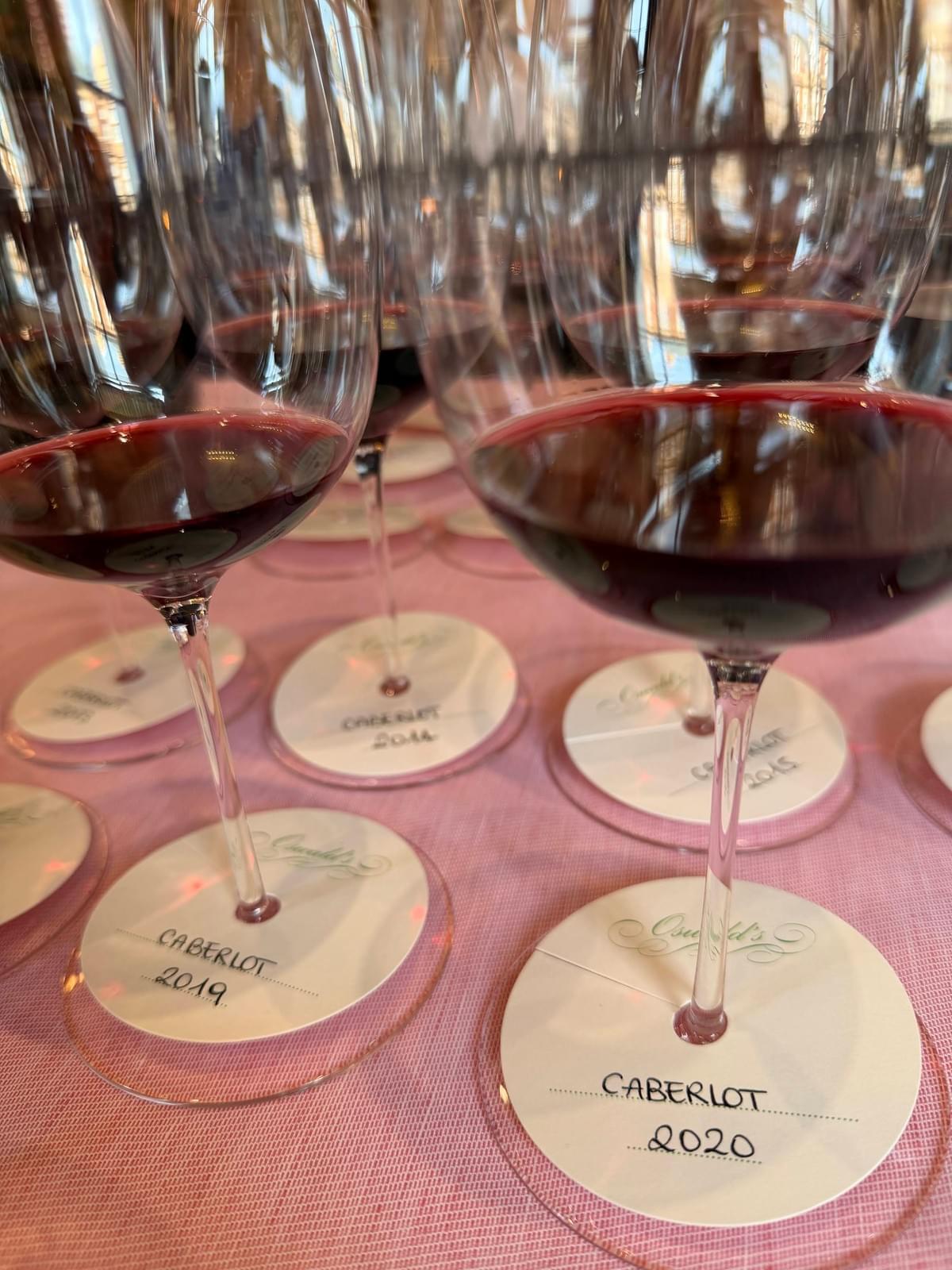
The wines combine structure, aromatic depth and balance, suggesting considerable ageing potential.
The 2020 vintage reveals a different side to Caberlot, offering openness and accessibility.
Compared with the more structured years, the wines have an immediately appealing character. The fruit profile is generous and expressive, and the tannins are relatively approachable, even at a young stage.
While still capable of ageing, the 2020 wines display a certain openness that makes them particularly enjoyable in their youth.
2021: precision and energy
The youngest wine presented at the tasting, the 2021 vintage, reflects another successful season at the estate.
A long ripening period allowed the grapes to develop maturity and freshness. The resulting wines have vibrant acidity and an energetic structure, suggesting considerable ageing potential.
Taken together, these vintages reveal something essential about Caberlot.
The grape does not behave as a stable template, repeated year after year. Instead, it acts as a kind of climate recorder.
Warm seasons produce generous and broad wines. Cooler years emphasise tension and aromatic lift. Extreme conditions leave structural marks that may take many years to soften.
For Podere Il Carnasciale, this variability is not something to be corrected in the cellar.
It is the very reason the wine exists.
The identity of Caberlot ultimately emerges not from a single perfect vintage, but from the ongoing dialogue between the vineyard, the climate, and time.
This is a wine that embraces uncertainty.
After tasting Caberlot across several vintages, it becomes clear that the wine does not aspire to perfection in the conventional sense.
In much of the fine wine world, excellence is often associated with consistency. The identity of a great estate is expected to remain recognisable, regardless of the year. Techniques in the cellar, vineyard management and blending decisions are often fine-tuned to iron out the irregularities of the climate and present a consistent house style from one vintage to the next.
At Podere Il Carnasciale, however, the philosophy moves in a quieter and more unusual direction.
The wines do not attempt to conceal the uncertainty of the season. Frost, drought, rain, heat, balance or generosity – each year leaves its mark, and Caberlot captures these differences remarkably clearly. The estate does not intervene to erase these differences. Instead, it allows them to remain visible, trusting that, over time, the dialogue between the vineyard and the vintage will reveal the true character of the grape variety.
This approach requires patience.
It also demands a certain humility in the face of nature. Caberlot is not treated as a variety that must be disciplined into stylistic uniformity. It is permitted to behave according to the conditions of each year, responding to the soil, the weather, and the slow rhythm of the vineyard.
In this sense, Caberlot is more than just a rare Tuscan wine.
It is an ongoing conversation between place, climate and time — one that continues to unfold with every vintage.
My sincere thanks go to Moritz Rogosky and the Rogosky family of Podere Il Carnasciale for sharing their wines and their story with such openness.
Thanks also to Raeburn Fine Wines for organising a thoughtful tasting that allowed us to experience these wines across multiple vintages. Encounters like this remind us that behind every remarkable bottle are not only vineyards and vintages, but also the people who choose to preserve their unique identity.