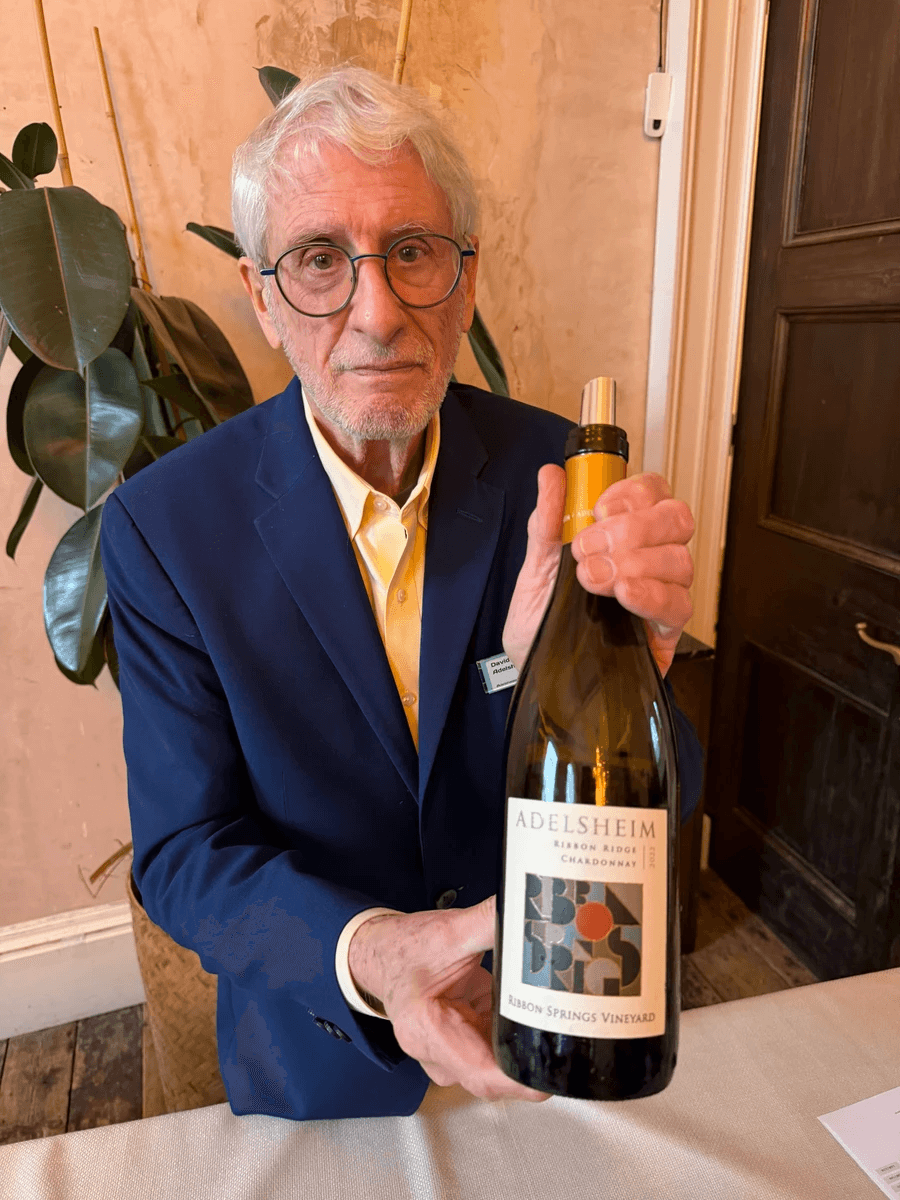
How a man who learned from weeds, believed in collaboration over competition, and bet everything on soil built one of the most distinctive wine regions in the world.
There are people in every industry who build empires, and there are people who build foundations. David Adelsheim belongs to the second, rarer category. Over more than five decades in the Willamette Valley, he has done something that very few winemakers anywhere in the world have managed: he helped create not just a winery, but an entire wine region's identity — and he did it by insisting, stubbornly and quietly, that everyone around him could rise together.
I first met David Adelsheim in London, thanks to an introduction by Kate Sweet — one of those connections that, in the wine world, feels less like chance and more like inevitability. Our conversation began there and continued at Wine Paris, where the interview that forms the backbone of this article took place.
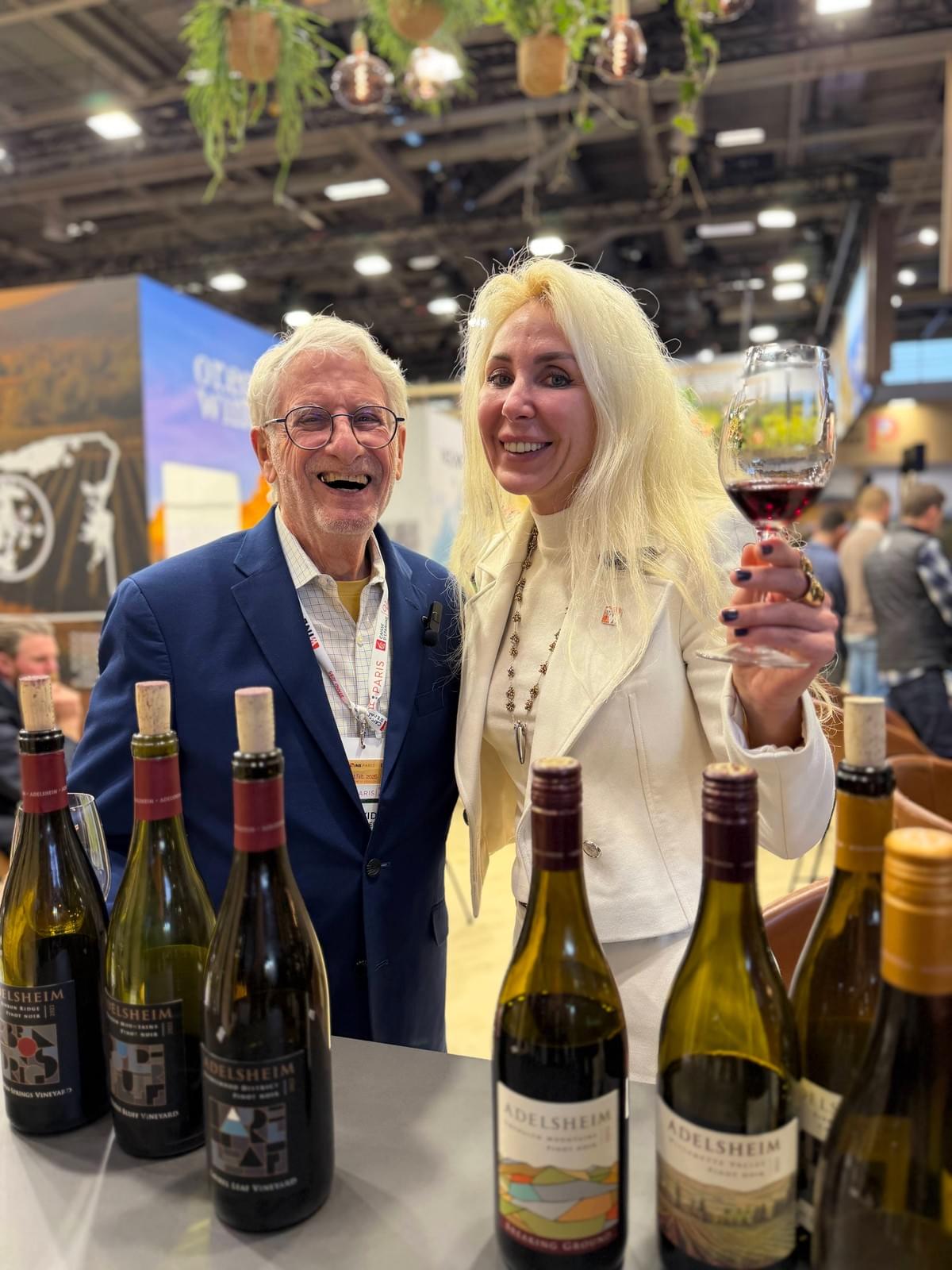
When I sat down with Adelsheim, I told him that some people compare him to Robert Mondavi. He smiled at that, neither accepting nor rejecting the comparison. In truth, the parallel is both apt and misleading. Like Mondavi, Adelsheim is a visionary who saw what others could not. But where Mondavi built a brand that became synonymous with Napa, Adelsheim built something more diffuse and, arguably, more durable: a culture of collaboration that made the Willamette Valley a world-class name in wine.
His story is not one of grand gestures but of deliberate choices — some of them productive mistakes, as he calls them — that accumulated over decades into something extraordinary.
The Lesson of the Weeds
The Willamette Valley of the early 1970s was, as Adelsheim himself puts it, a wild west. There was no established roadmap, no manual for growing Pinot Noir in this corner of the Pacific Northwest. The pioneers — and Adelsheim was among the very first — were improvising, reading the wrong books, and learning from the soil beneath their feet, often the hard way.
I asked him about his most significant productive mistake from those early years. He didn't hesitate.
"A fairly big mistake we made at the beginning was that we didn't understand how important weeds were. When we planted the vines, we left the weeds in, and then the weeds grew much more than the vines grew, and we lost the vines by and large."
— David Adelsheim
It sounds simple — almost naive — but that initial failure with weed management became one of the defining lessons of Oregon viticulture. The young vines, starved of water and light by the unchecked weeds around them, simply couldn't survive. The first instinct was to swing to the opposite extreme: clean cultivation, stripping everything away. Over the years, though, Adelsheim and his peers found a middle path, one that would eventually align with the modern language of sustainability.
"We're trying more and more to leave the weeds there, but you can't do it when the vines themselves have no source of water, and the water from the vine is being sucked away by all the weeds."
— David Adelsheim
I suggested that perhaps the vine should struggle. He corrected me immediately, with the quiet authority of someone who has thought about this for fifty years.
"The vine shouldn't struggle. Particularly when it's that young. It has to get established and it has to live. It's got to prosper. And to a certain extent, we were reading books about amateurs and not about viticulture."
— David Adelsheim
That last line stayed with me. Reading books about amateurs and not about viticulture — it's a remarkably honest admission from a man who is now considered one of the foremost authorities on the subject. But it also reveals something essential about the Oregon wine story: these were not corporate entities executing a business plan. These were individuals with a romantic attachment to the land, learning in real time, making mistakes that would become the region's wisdom.
The weed problem taught Adelsheim something that now sits at the heart of his philosophy: you want to preserve the soil's ability to let the vines grow on their own, without irrigation, without artificial intervention. You want balance. Finding that balance, he admits freely, took decades of trial and error.
You really want to preserve the ability of the vines to grow on their own.
Trying to find that balance in the beginning, we didn't know what we were doing.
David Adelsheim
The Radical Act of Collaboration
If you ask anyone in the international wine trade what makes the Willamette Valley different, they will eventually arrive at the same word: collaboration. It is the region's defining trait, and David Adelsheim is, more than anyone, the person who enshrined it.
In most wine regions, the default mode is competition. You guard your techniques, you promote your label, you differentiate at the expense of your neighbour. The Willamette Valley went the other way — and it didn't happen by accident.
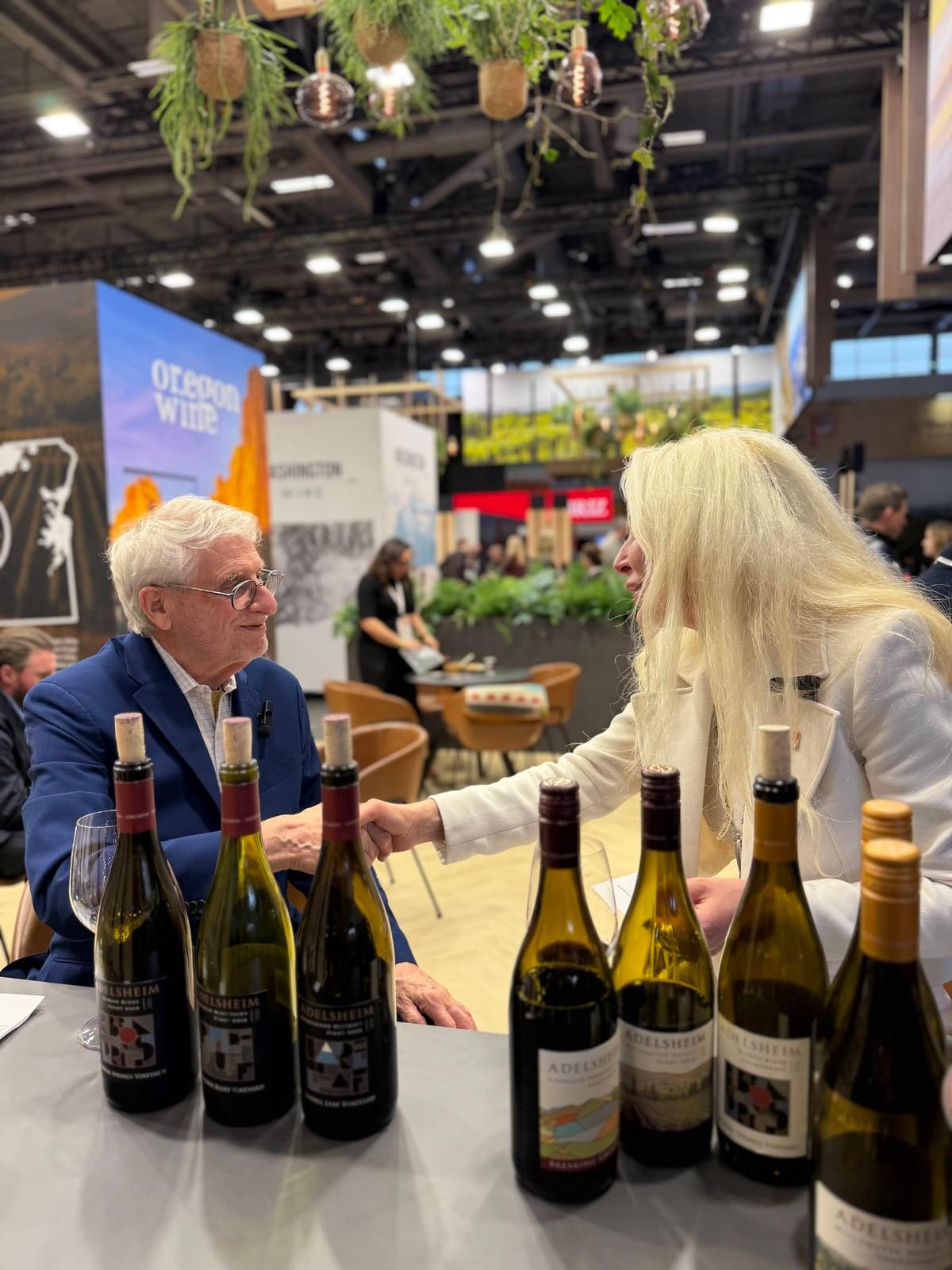
I asked Adelsheim why, in those early years, he didn't simply build his own brand in isolation. The Steamboat Pinot Conference, the shared technical knowledge, the collective promotion — where did the instinct for all of this come from?
"My guess is that the collaborative idea came, to a certain extent, from Chuck Coury, from Dick Erath. Those two in particular were, in very different ways, really promoting the idea that collaboration will get much further ahead than if we work separately."
— David Adelsheim
(Both Coury and Erath were UC Davis graduates who arrived in the Willamette Valley in the mid-1960s and are widely regarded as the founding fathers of Oregon wine. Coury — the theoretician — built the intellectual case that the valley's climate mirrored Burgundy and Alsace, and famously brought in his own Pinot Noir clone, allegedly smuggled from France. Erath — the practical pioneer — proved the concept was commercially viable, producing his first vintage from a garage in 1969 and later building one of Oregon's first major brands in the Dundee Hills.)
Adelsheim didn't just absorb this idea — he became its most consistent and vocal champion for the next half century. And when he talks about it now, there's no uncertainty in his voice. He knows it worked.
"I still think that collaboration is, in fact, the thing that defines the Willamette Valley as different from other places. And why, sixty years on, Willamette Valley is well-known around the world and other places that started at the same time, even earlier, are less well-known — because the winemakers, the winegrowers, did things on their own, but not collaboratively."
— David Adelsheim
Then he offered what might be the most elegant definition of collaboration I've ever heard in any industry:
What is collaboration? It means thinking of other businesses
as a means of increasing promotion, not increasing competition.
David Adelsheim
It's a deceptively simple idea, but executing it requires an ego rare in winemaking — or, more precisely, a certain kind of ego, one secure enough to see a neighbour's success as your own. Adelsheim has this quality in abundance. When I mentioned that everywhere I go in the wine world — London, Paris, the trade fairs — people point to him as the person who knows everything about Oregon, he simply noted, with characteristic understatement, that Adelsheim Vineyard may not always be the first winery someone seeks out, but they are always among the handful that perform.
"We always come out well. We may not be the winery that somebody looks for, but we're certainly among the handful of wineries that always, always perform."
— David Adelsheim
There's a book he wants to write — about the specifics of what collaboration means and how the Willamette Valley adopted it as a founding principle. He isn't sure he'll get to it. I hope he does. The wine world needs that book.
Clones: The Burgundy Connection
One of David Adelsheim's most consequential contributions to American winemaking is also one of the most technical: the introduction of the Dijon clones. It is a subject that can sound dry to outsiders but, in the world of Pinot Noir, it is the equivalent of a revolution.
In the 1970s, Oregon had access to a very limited number of vine clones, mostly sourced from California. The options were narrow. Adelsheim, who had spent time studying in Burgundy, noticed something critical: the Chardonnay clones there were ripening two to three weeks earlier than the clone they were using in Oregon. For a cool-climate region where every week of the growing season matters, this was transformative information.
"I saw the Chardonnay clones in Burgundy and realised they were picking them two or three weeks earlier than the clone that we had from California. I thought we had to have that clone of Chardonnay. And at the same time, of course, the Pinot clones."
— David Adelsheim
By importing the Dijon clones — Chardonnay and Pinot Noir — Adelsheim didn't just expand the genetic toolkit available to Oregon winemakers. He gave the region a palette. Where before there were two clones of Pinot Noir, suddenly there were seven or eight, each with subtly different characteristics, each responding differently to Oregon's specific soils and microclimates.
But here is what matters most: the goal was never imitation. I pressed Adelsheim on this point — whether the temptation existed to simply replicate the Burgundian style using Burgundian plant material. His answer was characteristically thoughtful. It's hard to fully remember what they were thinking, he said, but the intent was always to use the clones to discover what Oregon itself could produce, not to copy someone else's answer.
A Region Unlike Any Other
Today, the Willamette Valley is one of the most specialised wine regions in the New World. As Adelsheim points out, it is a place where roughly 70% of production is a single variety — Pinot Noir. "That doesn't exist in the New World," he says. "We're the only place that really is that specialised." This concentration is not a limitation. It is a declaration of identity.
Three Soils, One Mountain
If collaboration is the philosophical heart of Adelsheim's approach, then soil is its physical one. And it is here, talking about the Chehalem Mountains, that you see the fire in him burn brightest.
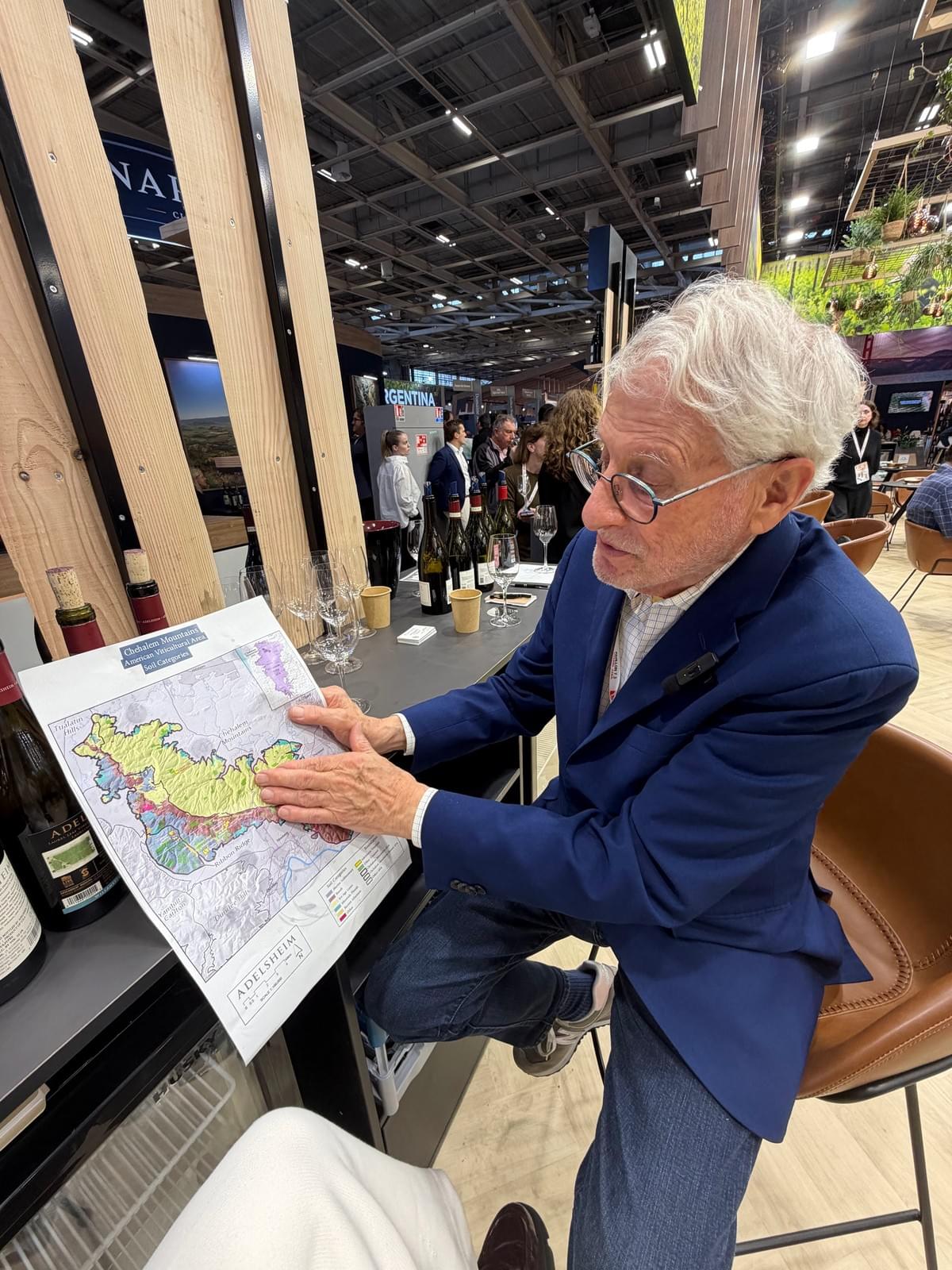
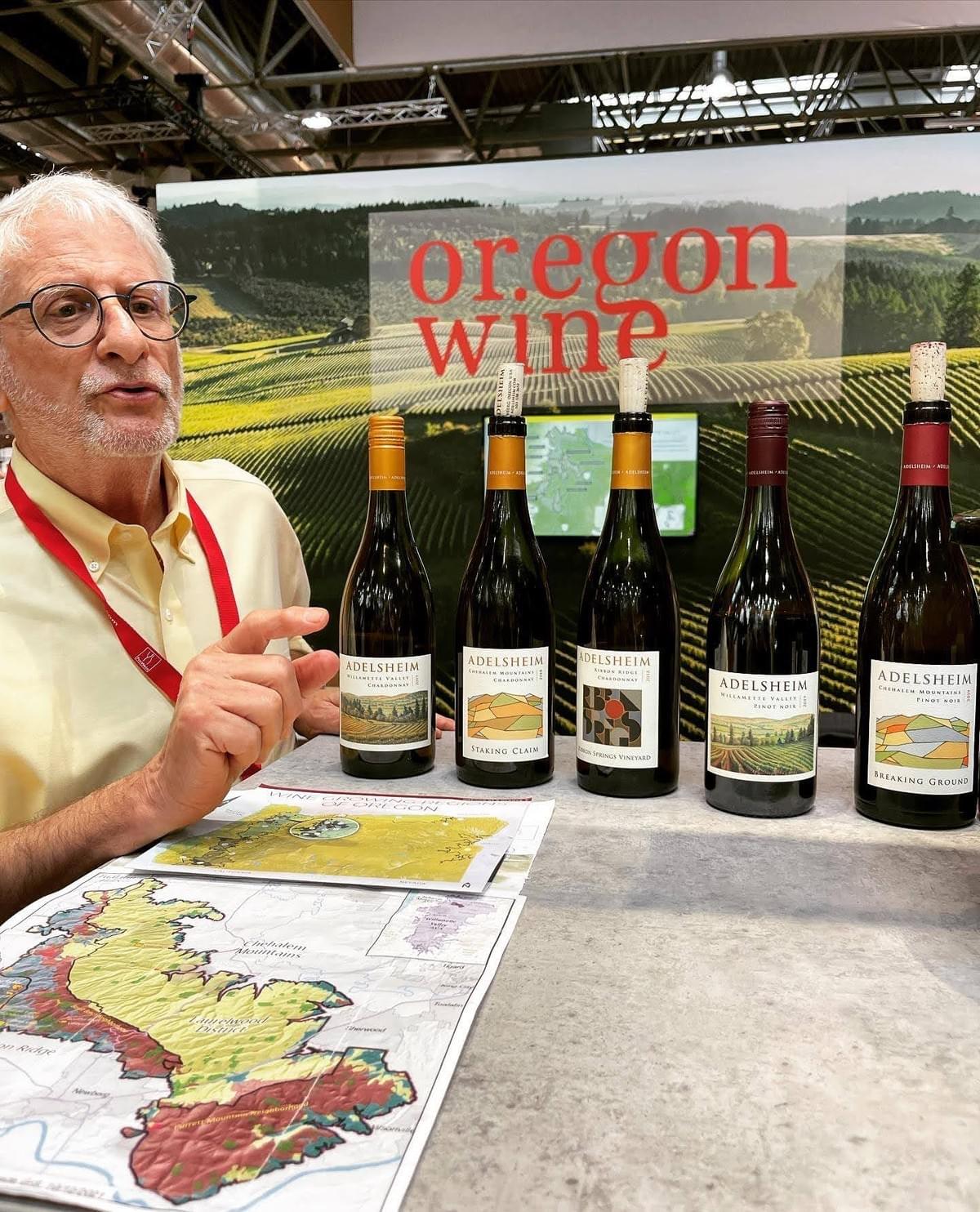
Adelsheim Vineyard's holdings are concentrated entirely in the Chehalem Mountains AVA, and this is not an accident. It is a deliberate choice, because the Chehalem Mountains offer something almost uniquely extraordinary: three entirely different soil types within a single appellation.
"The three soil types — the loess, basalt, and the marine sediment — are entirely different from each other, and yet they're all in this one AVA, this one appellation. We really focus on showing people that the soil is critical and it makes a critical difference to the wine."
— David Adelsheim
Loess — the fine, wind-blown sediment deposited during the ice ages. Basalt — the ancient volcanic rock. Marine sediment — the remnants of a sea floor from millions of years ago. Each produces a fundamentally different expression of Pinot Noir, and Adelsheim has structured his entire winemaking program around revealing these differences. He has single-vineyard wines from each soil type, designed not as trophies but as demonstrations.
"I'm not sure that any other winery is as focused on the site as we are. It's not that they aren't focused on site generally, but to be so specific, to have single vineyards that represent one soil and to differentiate three of them — there's no other AVA with three different soils."
— David Adelsheim
This is not marketing language. When Adelsheim says he can show you three single vineyards from three different soils and let you taste the difference in your glass, he means it literally. It is the culmination of everything he has learned — from the weeds that killed his first vines to the Burgundian clones he brought home to the collaborative spirit he championed. All of it converges in these three bottles from three soils on one mountain.
The reality is, the thing that really distinguishes us
more and more is where our vineyards are.
David Adelsheim
The Architect's Legacy
David Adelsheim is not a man who speaks in grand statements about legacy. He is more comfortable talking about loess and basalt, about vine spacing and clone selection, about the specific technical details that separate a good wine from a great one. But legacy is what he has built, whether he is comfortable with the word or not.
He helped create a wine region that the world now takes seriously. He did it not by dominating but by collaborating, not by imitating but by listening to what the land was telling him. He made mistakes — with weeds, with cultivation, with the inevitable miscalculations of anyone working without a map — and he turned every one of those mistakes into knowledge that he then shared freely with his neighbours.
He wants to write a book about collaboration. There are single-vineyard Pinot Noirs that continue to demonstrate the astonishing diversity of the Chehalem Mountains. There is a winery that, as he says, always performs. But perhaps the truest measure of David Adelsheim's legacy is this: when you ask anyone in the wine world about Oregon, his name is the first one spoken. Not as a brand. As a person. As the quiet architect who built the house that everyone else now lives in.
And he's still building. I'm grateful to Kate Sweet for that first introduction, and to the halls of Wine Paris for giving us the space to have this conversation. Some interviews are about collecting quotes. This one felt more like witnessing a man take quiet stock of a life's work — and deciding, without any fanfare, that there is still more to be done.